The binomial theorem
This
is the binomial theorem, and it’s a way to fill slots with combinations of ‘s and ‘s that happens to also be a way to compute the coefficient of a binomial expansion. How so?
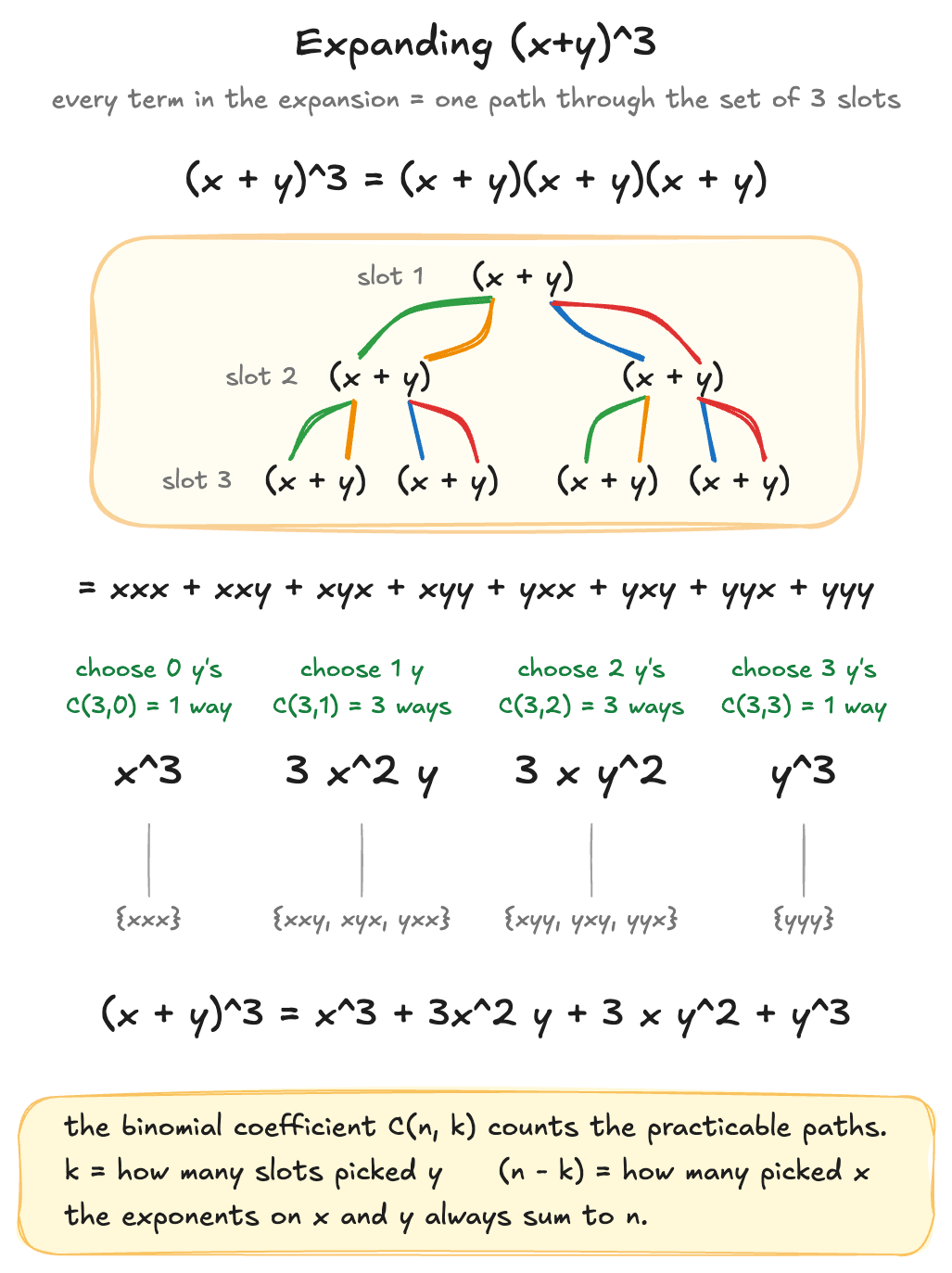
Expanding a binomial
Expanding a binomial is the result of combining—by multiplying, because each factor is an independent choice and the product rule is applied— times the binomial’s elements and , here with as the diagram above shows
What the binomial theorem is really saying, thus, is that a binomial expansion is the sum of all the combinations of the binomial elements and required to fill sized slots—since, and maybe obviously, —or, in other words, that every term in the expansion is one path through those slots.
Compact expansion
What this means, in other words, is that each step of the summation counts—because summing is counting—the number of times a specific combination of the binomial elements (-times the first and -times the second) appears in the final expansion.
In example above, the second , third and fifth addends are no more than the elements resulting from the summation step with
that is
and that is like saying that an addend consisting of times and time appears times—and as the result of the binomial coefficient , that is telling me in how many ways and indistinguishable elements can be arranged—in the expanded binomial that, in turn, means that is the coefficient of the expanded binomial element with —and consequently and inevitably .
A worked example
Find the coefficient of in
Recall : what are my and and here? Given the obvious , and map into the theorem like
These are just symbols, that happen to take the form of numbers, but they really can be just literally anything, and need to be treated as such!
Here I’m doing algebra and I want to make mathematical operations on them, because they are many—example expanded has addends—and I want to have a compact notation, and numbers happen to be a really compact notation—writing 1M is indeed more compact than collecting 1M pebbles—but their function is just to serve as bases for the and exponents that in turn represent really just a number of repetition (remember exponentiation is repeated multiplication): and repetitions!
So, if i want to know the coefficient of —equivalently in —the exponent of must be . When mapping the binomial elements to and there’s therefore absolutely really nothing to think about, just go autopilot, even though the second binomial element has no attached variable or exponent in : its combination’s exponent is just the number of times i have to take in that precise expansion addend (step of combinations summation) that corresponds to !
Thus
and is the expansion element with exponent . And that also shows how the actual number of possible ways to arrange a number of elements and a number of elements is entirely given by the binomial coefficient ; the multiplication by the coefficients of each binomial element in turn represents just an algebraic tool, not a combinatorial one, to find the expansion’s coefficients.