The “order doesn’t matter” in combinations
In the combinations formula (equation in sum-and-product-rule-permutations-and-combinations)
the first in the denominator is the “order doesn’t matter” element, it acts as a deduplicator, removing duplicate arrangements that differ only in element order.
A subtle case of confusion
However, when I considered the classic combinatorics problem of finding the number of paths within a grid, such as
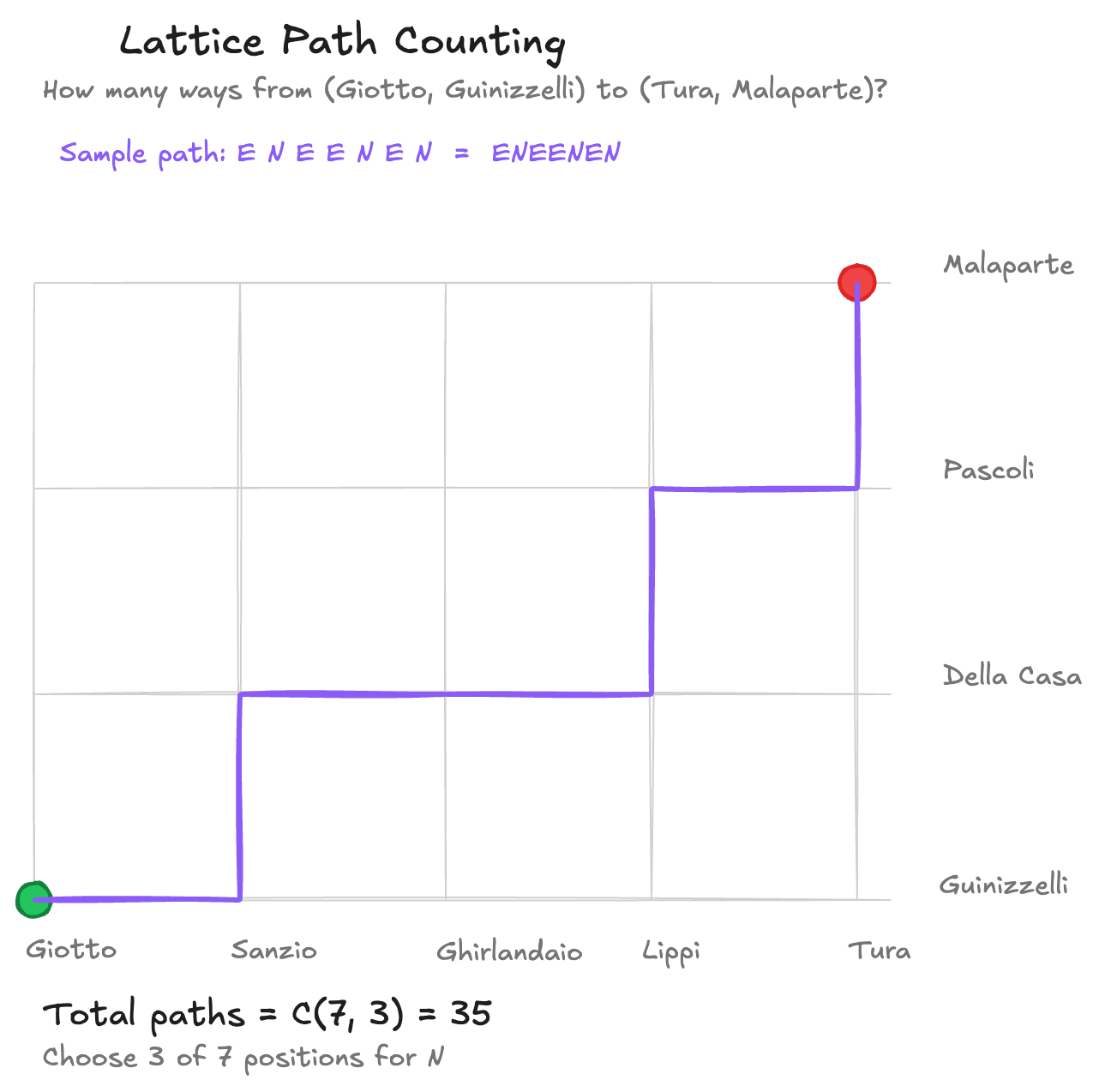
something felt off.
Lattice path counting solution
The problem solution is simplified by leveraging the binomial coefficients symmetry
and modeling as a single combination, because by choosing the 4 East steps, the 3 North steps become a residual, implied by the first choice—no degrees of freedom remain. Therefore, to find the number of possible paths I compute either the North or the East steps combinations, the others follow accordingly and inevitably.
Combinations vs. Permutations
But that for combinations is the “order doesn’t matter” combinatorics formula, nevertheless here order does matter: is different from —at first sight, this could therefore look more like a permutation
where ordering precisely matters, than a combination.
What the first in really is?
But the ordering that matters in path counting problems is the ordering of the whole arrangement, whilst the first in actually gets rid of ordering within the chosen elements’ set. In other words, I’m not choosing which North step goes into step , I’m choosing whether step gets a North or an East step: I’m choosing the positions not the elements that need to be instead considered indistinguishable.
What the first in —the deduplicator—is really saying, thus, is that the North (or East for what matters) steps , , are indeed the same thing, but it sort of whispers it subtly as “order doesn’t matter”: the first in the denominator of is a deduplicator/anonymizator.
This is another application of a counting correction mechanism, like in inclusion-exclusion-principle.
On identity
There, lying, is a deep philosophical question about identity: what is identity?
identity is what makes exchanging two elements noticeable